
Last Updated: October 26, 2026
Quick Summary
You can find local utv repair shops in Michigan by matching each shop's specialty to your specific machine rather than choosing the closest address. Confirm UTV-specific experience, supported makes and models, a clear diagnostic process, and a written estimate before you book. Dealers suit warranty work, while independent shops often handle performance work and older machines.
- Confirm four things before booking: UTV-specific experience, supported makes and models, a clear diagnostic process, and a written estimate.
- Diagnostic fees commonly run $75-$150 at independent shops and $100-$200 at dealerships, often credited toward the repair.
- Book service at least three to four weeks out and confirm parts are on the shelf before a planned trip.
- Mobile service suits belt swaps, diagnostics, and electrical work, not engine rebuilds or suspension revalving.
- Dealers are the safer bet for warranty claims and recalls; independent shops suit performance work and older machines.
Table of Contents
- How to Find Local UTV Repair Shops in Michigan
- What to Verify Before You Book
- UTV Repair Near Me: Matching the Shop to Your Machine
- What UTV Repair Cost Actually Covers
- DIY UTV Maintenance You Can Handle at Home
- UTV Dealer Service vs Independent Shop
- Mobile, Pickup, and Delivery Options Across Michigan
- Book Your UTV Service at SXS MAYHEM in Perry
- Frequently Asked Questions
How to Find Local UTV Repair Shops in Michigan
Finding local UTV repair shops in Michigan starts with matching the shop's specialty to your machine, not just picking the closest address. A shop that services ATVs and snowmobiles may never have opened the clutch cover on a turbocharged side-by-side.
The stakes are higher than they look. A side-by-side that fails on a rocky trail two hours from the truck is a recovery problem, not a repair problem. Choosing the right shop the first time is the cheapest maintenance decision you'll make all season.
Below, we break down how to vet a shop, what to ask, and which jobs you can safely handle in your own garage.
What to Verify Before You Book
Before you hand over a machine, confirm four things: UTV-specific experience, supported makes and models, a clear diagnostic process, and a written estimate. Most booking mistakes happen because riders ask about price first and capability second.
Start with the questions that separate a general powersports service center from a UTV specialist:
- Which makes and models do you service regularly, and do you stock or source parts for older machines?
- Do you run a diagnostic before quoting, and is the diagnostic fee credited toward the repair?
- What is your expected turnaround, and how do you handle parts backorders?
- Do you provide a written estimate before work begins?
- What is your policy if a part does not fit or does not perform as expected?
That last question matters more than most riders realize. CV boots and axle components take a beating on tight, rocky trails, and repeat failures usually trace back to installation angle or boot quality rather than bad luck. If you want to understand what a shop should be checking, our breakdown of why UTV CV boots keep failing covers the common causes and fixes.
UTV Repair Near Me: Matching the Shop to Your Machine
Searching "UTV repair near me" returns plenty of results. The useful filter is whether the shop works on your specific machine and terrain.
A family running a stock four-seater on sandy two-tracks has different needs than a racer running a built machine on rocks. Ask directly: do you work with racers, or are you geared toward casual riders? A good shop answers honestly, because the tooling and tuning differ.
UTV-Specific Expertise and Supported Makes
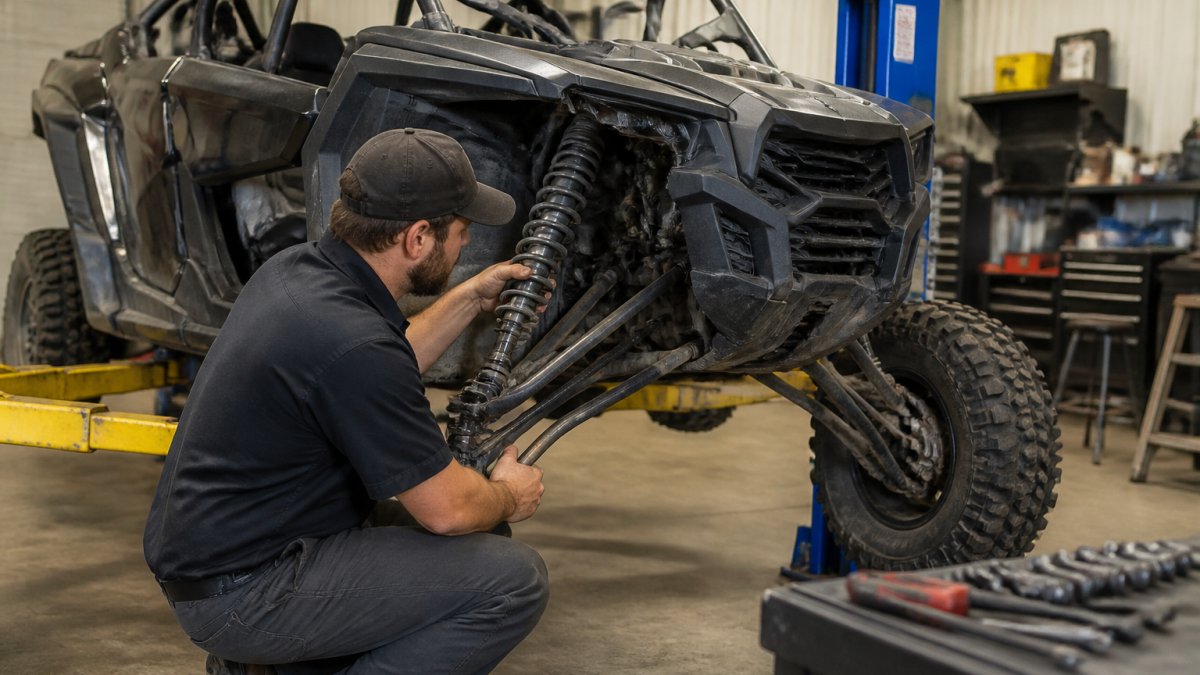
UTV-specific expertise means the shop knows side-by-side drivetrains, not just small-engine repair. That covers clutch and belt systems, differentials, suspension geometry, and the electronics that control them. General small-engine repair is a different skill set, and it is worth confirming which one a shop actually offers.
Ask which makes and models they see most often. A shop that services your brand weekly will have the torque specs, common failure points, and parts sources already sorted. One that sees your machine once a year will be learning on your dime.
What UTV Repair Cost Actually Covers
UTV repair cost is driven by four variables: the job, the parts, the diagnostic time invested before quoting, and the machine itself. Most shops will not give a firm number over the phone, and you should be suspicious of any that do. What a good shop will give you is a written estimate broken into diagnosis, parts, and labor, and a realistic range for the work.
Here is how those ranges typically break down for common side-by-side jobs. Treat these as planning figures, not quotes; your machine, your region, and parts availability all move the number.
- Diagnostic fee: Commonly $75-$150 at independent powersports shops, and often $100-$200 at dealerships. Many shops credit the fee toward the repair if you authorize the work. Always ask before you drop the machine.
- Belt replacement: $150-$350 for the belt and labor on most stock machines. Performance belts and clutch work push toward the top of that range or beyond.
- Clutch service or rebuild: $400-$900 depending on whether the shop replaces springs, weights, and cover components or just inspects and cleans.
- CV boot and axle service: $200-$500 per corner, depending on whether the axle is rebuilt or replaced and whether the boot failed cleanly or contaminated the joint.
- Top-end rebuild: $800-$2,000 for a single-cylinder or twin-cylinder trail machine, more for high-performance engines with valve work.
- Bottom-end rebuild: $2,000-$4,500 and up after a catastrophic failure, because case splitting, crank service, and gasket sets add up fast.
- Suspension work: $150-$400 for bushing and bearing replacement, $600-$1,200 per shock for revalving and spring work on performance setups.
- Fluid and filter service: $150-$300 for a full service including oil, filter, differential fluid, and a fastener check.
Turnaround is the other half of cost. A belt swap is often same-day or next-day. A top-end rebuild is commonly one to two weeks. A bottom-end rebuild can run three to six weeks if the shop has to source a crank or case half. Ask for the shop's current turnaround before you commit, and ask what happens if a part is backordered, a good shop will tell you whether they can source an aftermarket equivalent or whether you will wait on OEM.
Parts availability is the wild card. Older machines and less common brands can sit for weeks waiting on a single component.
For current pricing on parts and service, check our site or call the shop directly. We would rather give you an accurate number than a fast one.
Here are the typical planning ranges the article gives for common side-by-side jobs.
| Job | Typical cost range | Note |
|---|---|---|
| Diagnostic fee | $75-$150 independent; $100-$200 dealership | Often credited toward the repair |
| Belt replacement | $150-$350 | Performance belts and clutch work push higher |
| Clutch service or rebuild | $400-$900 | Depends on parts replaced vs. inspect and clean |
| CV boot and axle service | $200-$500 per corner | Rebuilt or replaced axle changes the price |
| Top-end rebuild | $800-$2,000 | More for high-performance engines with valve work |
| Bottom-end rebuild | $2,000-$4,500 and up | After a catastrophic failure |
| Suspension work | $150-$400 bushings; $600-$1,200 per shock | Revalving and spring work on performance setups |
| Fluid and filter service | $150-$300 | Oil, filter, differential fluid, fastener check |
DIY UTV Maintenance You Can Handle at Home
Some maintenance genuinely belongs in your garage. Oil and filter changes, air filter cleaning, belt inspection, fastener checks, and tire pressure are all jobs most owners can handle with basic tools and a service manual.
Suspension setup is the next step up, and it pays off on rocky terrain. If you ride rocks, our guide on how to improve UTV suspension for rocky trails walks through the adjustments in order.
Where DIY goes wrong is guessing. A common mistake is buying a part that looks right on paper without confirming fitment for your exact model year. Measure, check the part number, and ask before you order.
UTV Dealer Service vs Independent Shop
Dealer service brings factory training, warranty alignment, and brand-specific diagnostic tools. Independent shops bring flexibility, often faster turnaround, and a willingness to work on modified machines that a dealer may decline.
The honest trade-off: dealers are the safer bet for warranty claims and factory recalls. Independent shops tend to be better for performance work, older machines, and riders who want to talk to the person actually turning wrenches.
Ask both the same question: what is your turnaround right now? A shop that cannot give you a realistic window before you drop the machine is telling you something.
Mobile, Pickup, and Delivery Options Across Michigan
Mobile repair and pickup service exist, but availability varies widely by region and season.
Mobile service is best suited to jobs that need hand tools and a diagnostic scan, not a lift and a clean bay.
Pickup and delivery is the middle option. Many independent shops will pick up a non-running machine for a flat fee within a local radius, and deliver it back when the work is done. This is usually the right call when the machine will not start, when you do not have a trailer, or when the repair is too large for mobile service. Confirm whether the pickup fee is charged each way and whether it is credited against the repair.
Coverage is the part riders get wrong. A shop that advertises mobile service may only travel 20-30 miles from its bay, and coverage can shrink during peak season when the shop is backed up.
If you are weighing a long drive against shipping parts, ask the shop both questions. Many riders ship parts and handle installation locally, while others prefer to have the work done in-house. Neither is wrong.
Book Your UTV Service at SXS MAYHEM in Perry
SXS MAYHEM is a family-owned shop built by riders who race and repair their own machines. We stock a curated selection of parts and accessories for SXS and UTV owners, and our service department handles repair, installation, and tuning for trail, rock, and dune setups.
If you have an older machine and you are tired of hunting parts online, call us. We will tell you honestly whether we can source what you need.
Get started with SXS MAYHEM and get your machine dialed in before the next ride.
Frequently Asked Questions
How do I find a reliable UTV repair shop near me?
Start by confirming the shop actually works on UTVs rather than only ATVs or motorcycles, then ask which makes and models they service. Check customer reviews for patterns, not just star ratings, and ask whether they charge a diagnostic fee. A shop that explains its process, gives a written estimate, and can tell you its typical turnaround time is usually a safer bet than one that quotes a price over the phone without seeing the machine.
Is it better to use a dealer or an independent UTV repair shop?
Dealers are the right call for warranty work and factory recalls, since only an authorized dealer can perform those repairs without affecting coverage. Independent shops often have shorter waits, more flexibility on aftermarket parts, and mechanics who ride the same terrain you do. Many riders use the dealer for warranty items and an independent shop for everything else, including suspension work, tuning, and out-of-warranty engine repairs.
Which UTV repairs are safe to do yourself?
Oil and filter changes, air filter cleaning, belt inspection, tire pressure, brake pad checks, and fluid top-offs are all reasonable DIY UTV maintenance tasks with basic tools. Anything involving internal engine work, clutch rebuilds, ECU tuning, or suspension geometry is worth handing to a shop. If a repair requires splitting the case or torquing internal components to spec, a mistake gets expensive fast, and the labor savings rarely cover the cost of a second teardown.
How long does a UTV repair usually take?
Turnaround depends on the job and parts availability. Routine maintenance is often same-day or next-day, while a top-end rebuild or suspension install can run several days, especially if parts need ordering. Ask the shop two questions before you drop off: whether the parts are in stock, and what their current backlog looks like. A shop that stocks common parts for older machines will usually get you back on the trail faster.
